HomeCustom rubber components
Custom rubber components
Moulded rubber parts made to your drawing or specification. We supply the rubber components you already buy, from manufacturers we find, compare and manage.
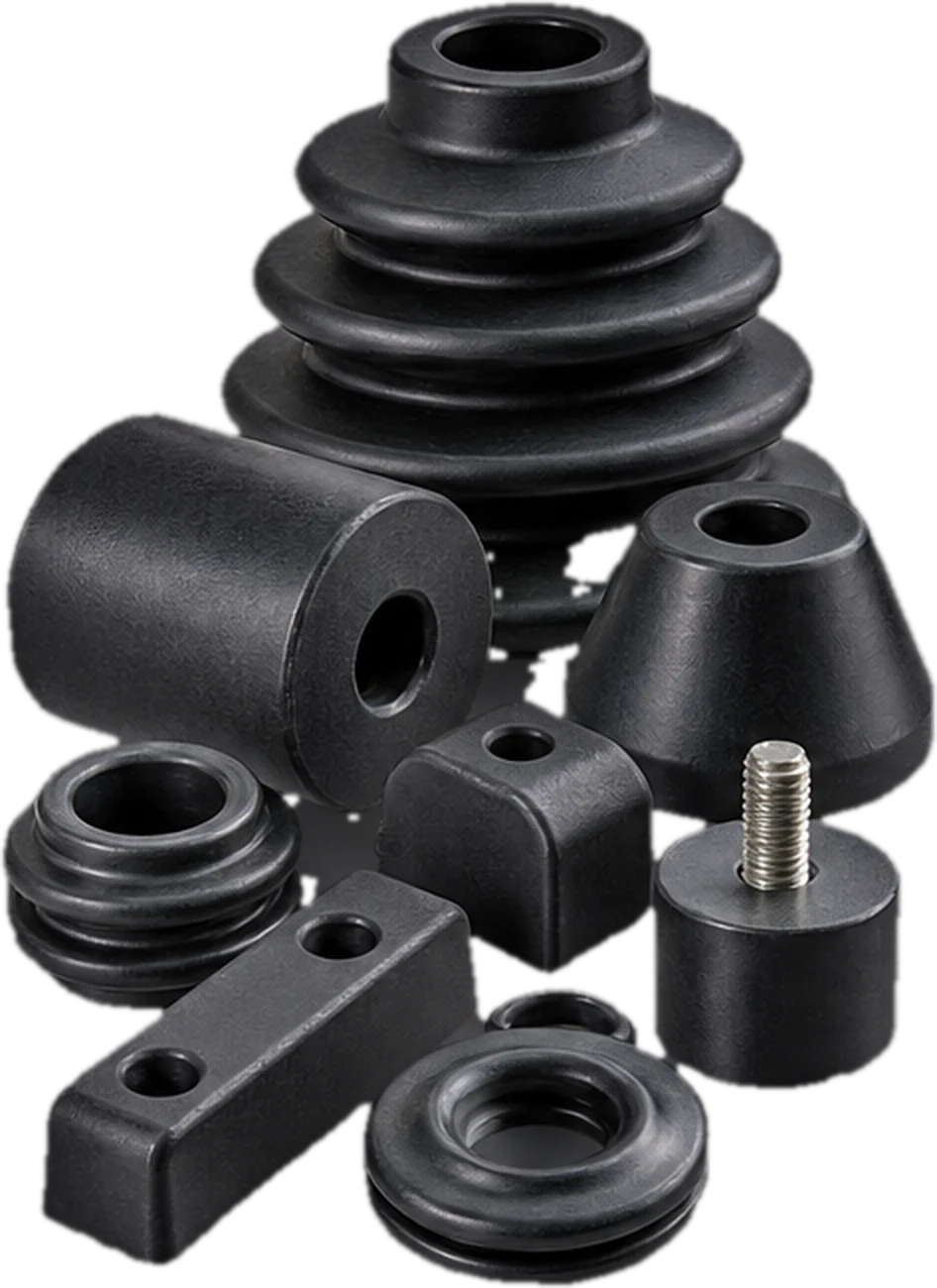
Typical parts
Recurring, custom-moulded components, not catalogue items.
- Feet, buffers and bump stops
- Grommets, plugs and bungs
- Grips, sleeves and covers
- Pads and anti-vibration mounts
- Boots, gaiters and bellows
- Simple rubber-to-metal bonded parts
Choosing the compound
The compound drives both performance and price. These are typical figures; the exact range depends on the grade and formulation.
| Compound | Typical temperature range | Oils and fuels | Weather and ozone | Often used for |
|---|---|---|---|---|
| Natural rubber (NR) | −50 to +70 °C | Poor | Poor | Buffers and mounts where resilience matters |
| EPDM | −40 to +120 °C | Poor | Excellent | Outdoor parts, water and steam |
| Nitrile (NBR) | −40 to +120 °C | Excellent | Poor | Parts in contact with oil, fuel or grease |
| Neoprene (CR) | −40 to +100 °C | Moderate | Good | General-purpose and marine parts |
| Silicone (VMQ) | −60 to +230 °C | Poor | Good | High or low temperature, food contact grades |
| Fluoroelastomer (FKM) | −20 to +200 °C | Excellent | Excellent | Aggressive fluids at high temperature |
Hardness is specified in Shore A or IRHD. Most moulded parts fall between about 40 and 80 Shore A.
How rubber parts are moulded
The right process depends on quantity, part shape and how tightly it needs to be controlled.
- Compression moulding
- A measured blank of rubber is pressed in a heated tool. Tooling is the simplest and cheapest, so it suits low to medium volumes and thick sections. Cycle times are longer and parts need more trimming.
- Transfer moulding
- Rubber is forced from a pot into a closed tool. It gives better dimensional control than compression and is commonly used where metal inserts are bonded into the part.
- Injection moulding
- Rubber is injected into a closed tool under pressure. Tooling and set-up cost more, but cycle times are short and flash is low, so unit cost falls at higher volumes.
What drives cost and order quantity
These are the things we compare between manufacturers before we quote.
- Compound
- Speciality materials such as FKM and some silicones cost several times more per kilogram than EPDM or natural rubber.
- Tooling
- The number of cavities sets the balance between tool cost and unit price. More cavities cost more up front and less per part.
- Tolerances
- ISO 3302-1 defines classes M1 (precision) to M4 (non-critical). Tighter classes need better tooling and more inspection.
- Finishing
- De-flashing, post-curing, bonding to metal and any assembly or kitting all add cost.
- Batch size
- Each run carries a set-up cost, so the minimum order quantity depends on how a manufacturer is equipped.
What we need to quote
- Drawing or specification, or an approved sample
- Compound and hardness, if known
- Annual usage and typical order quantity
- Critical dimensions and any tolerance class
- Colour, finish and any approvals the material must meet
- Whether tooling already exists and who owns it
A drawing is best. If you only have a sample, send what you have and we will tell you what else is needed.
Questions about rubber components
What rubber components does Francis Weybridge supply?
We supply custom moulded rubber components made to a customer’s drawing, specification or approved sample. Typical parts include feet, buffers, bump stops, grommets, plugs, grips, covers, pads, boots, bellows and simple rubber-to-metal bonded components.
What is the minimum order quantity for custom rubber mouldings?
It depends on the part size, compound and moulding process. Compression-moulded parts can be economical in the hundreds, while injection-moulded parts usually need larger runs to justify the tooling and set-up. We compare manufacturers partly on how well their minimum order suits your usage, and quote you on that basis.
Can you match an existing rubber part without a drawing?
Potentially. Some manufacturers can work from a physical sample, but a controlled drawing or specification that states the material, hardness and critical dimensions is the better basis, because it makes the part repeatable from any source.
Which tolerance standard applies to moulded rubber parts?
Rubber moulding tolerances are commonly specified to ISO 3302-1, which sets classes from M1 (precision) to M4 (non-critical). Rubber cannot hold the tolerances of machined metal, so the class should be agreed against the drawing before tooling is made.
Give us one part.
Have something you buy regularly?Let us see what else is possible.