HomeInjection-moulded plastic components
Injection-moulded plastic components
Custom moulded parts made to your drawing or specification. We supply the plastic components you already buy, from manufacturers we find, compare and manage.
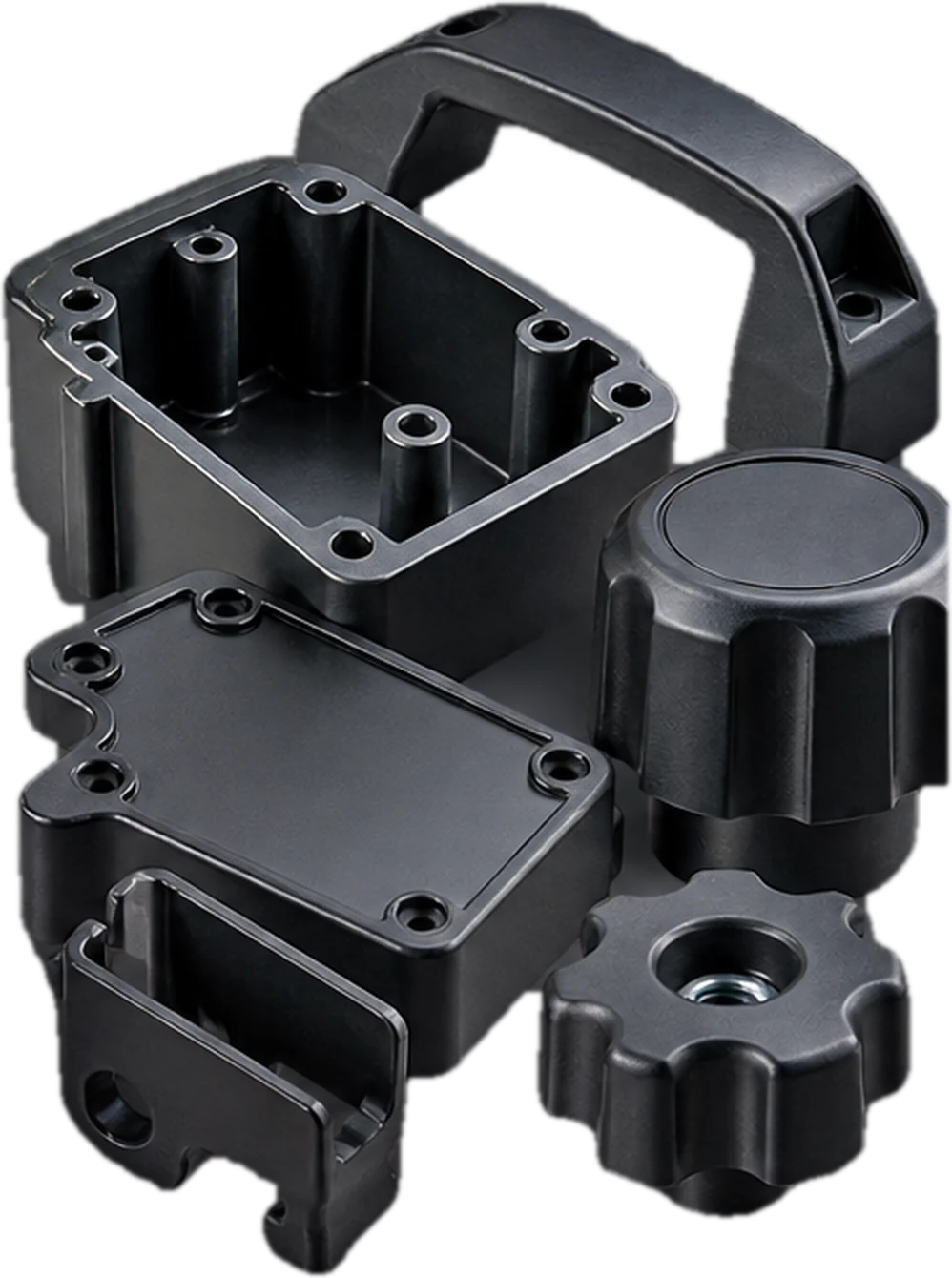
Typical parts
Recurring production components moulded in engineering and commodity plastics.
- Housings and enclosures
- Covers, lids and caps
- Knobs and handles
- Guards and guides
- Spacers, clips and bushes
- Parts with moulded-in inserts
Choosing the material
Material choice affects strength, appearance, dimensional stability and price. This is a general guide; grades and fillers change the picture.
| Material | Character | Shrinkage in the mould | Often used for |
|---|---|---|---|
| Polypropylene (PP) | Tough, chemical resistant, low cost | Higher | Caps, covers, living hinges |
| ABS | Rigid, good surface finish, easy to colour | Lower | Housings and visible parts |
| Nylon (PA6, PA66) | Strong and wear resistant, often glass filled; absorbs moisture | Higher | Clips, brackets, load-bearing parts |
| Acetal (POM) | Stiff, low friction, dimensionally stable | Higher | Gears, guides, bushes |
| Polycarbonate (PC) | Very tough, can be transparent | Lower | Guards, lenses, impact-resistant covers |
| Polyethylene (HDPE) | Tough, chemical resistant, flexible | Higher | Caps, plugs, containers |
| Thermoplastic elastomer (TPE) | Rubber-like, mouldable on plastic tooling | Varies | Grips, seals, soft-touch features |
Semi-crystalline plastics such as PP, nylon and acetal shrink more as they cool than amorphous plastics such as ABS and polycarbonate, which affects the tolerances a part can hold.
Tooling is the main decision
Most of the commercial difference between sources comes down to the tool.
- Tool material
- Aluminium or pre-hardened steel tools cost less and suit lower volumes. Hardened steel tools cost more and last far longer.
- Cavities
- A single-cavity tool is cheapest to build. Multi-cavity tools cost more but make several parts per cycle, lowering the unit price.
- Complexity
- Undercuts, threads, side actions and inserts add moving parts to the tool, and cost with them.
- Ownership
- Who owns the tool, where it is kept, how long it should last and what happens if you move it should all be agreed before the order.
What drives cost and order quantity
These are the things we compare between manufacturers before we quote.
- Material and colour
- Engineering grades, glass filling, flame-retardant grades and custom colours all raise material cost and can raise minimum batch size.
- Part design
- Wall thickness sets cooling time, and cooling time sets cycle time. Thick or uneven walls cost more and are harder to hold flat.
- Tolerances
- Achievable tolerances for moulded plastics are covered by ISO 20457, and depend on the material, the tool and how the dimension is formed.
- Finish and secondary work
- Surface texture, printing, inserts, ultrasonic welding and assembly are quoted on top of moulding.
- Batch size
- Each run involves fitting the tool and purging material, so very small batches carry a high set-up cost per part.
What we need to quote
- Drawing, and a 3D model if you have one
- Material, grade and colour
- Annual usage and typical order quantity
- Critical dimensions and surface finish
- Whether a tool exists, its condition and who owns it
- Any standards or approvals the part must meet
A drawing is best. If you only have a sample, send what you have and we will tell you what else is needed.
Questions about plastic components
What plastic components does Francis Weybridge supply?
We supply custom injection-moulded plastic components made to a customer’s drawing or specification, including housings, covers, caps, knobs, handles, guides, guards and spacers.
Who owns the injection mould tool?
Tool ownership should be agreed in writing before an order is placed, along with the tool’s expected life, where it is stored and the terms for transferring it. Where a customer pays for a tool, it is normal for the customer to own it.
Can an existing mould tool be moved to another manufacturer?
Sometimes. It depends on who owns the tool, its condition and whether it fits the new manufacturer’s machines. Where a transfer is not practical, a second tool can be made, which is one reason second sourcing is assessed part by part.
What quantities suit injection moulding?
Injection moulding carries a tooling cost, so it suits recurring parts. Simple single-cavity tools can make sense for a few thousand parts a year, while high-volume parts justify hardened multi-cavity tools. The right answer depends on the part and its expected life.
Give us one part.
Have something you buy regularly?Let us see what else is possible.