HomeMetal pressings and formed parts
Metal pressings and formed parts
Brackets, clips, plates and simple formed components made to your drawing. We supply the metal parts you already buy, from manufacturers we find, compare and manage.
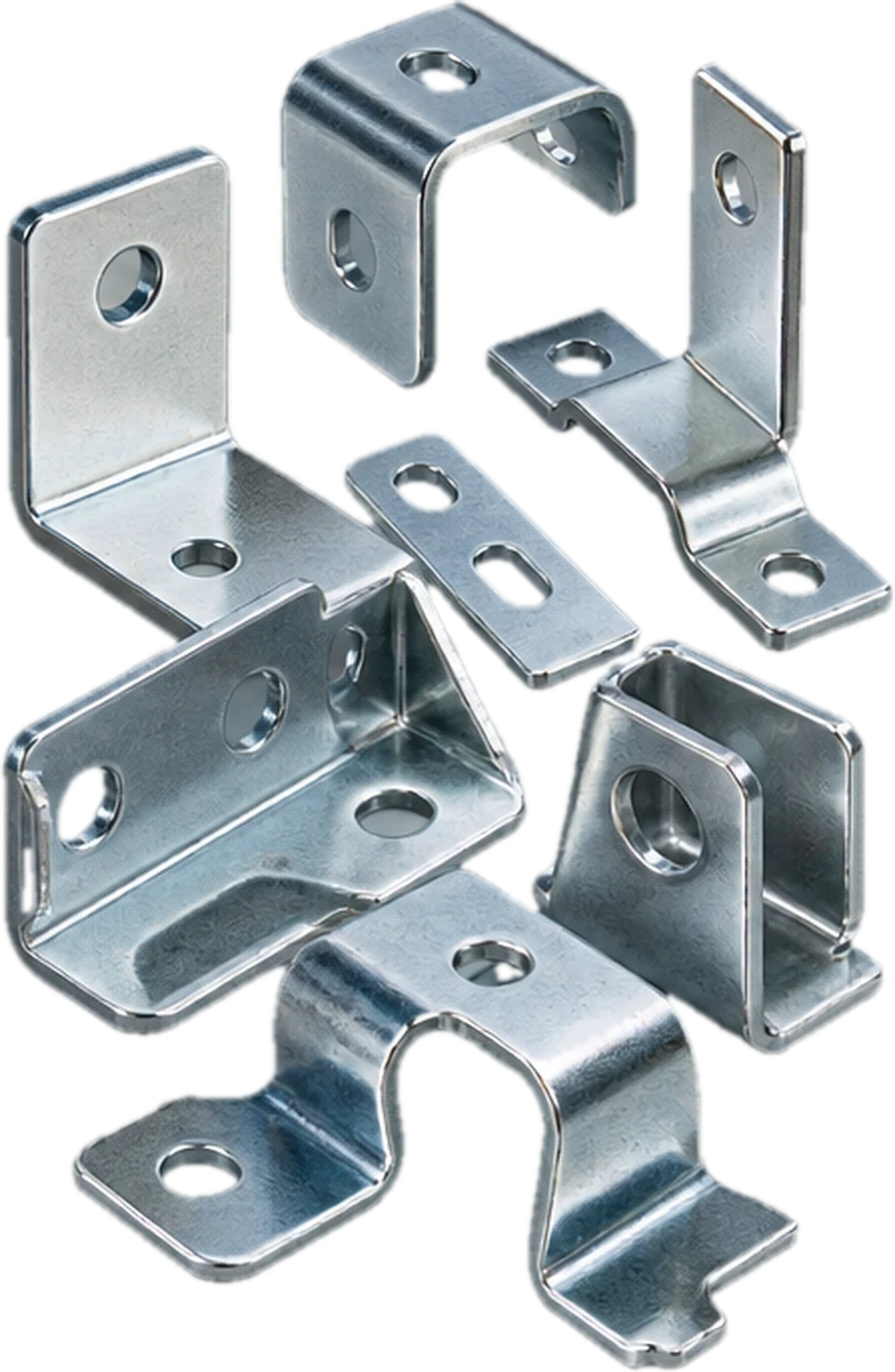
Typical parts
Recurring sheet and strip components, kept deliberately simple.
- Brackets and angle brackets
- Clips and retainers
- Plates, tabs and shims
- Guards and covers
- Straps and saddles
- Simple fabricated or welded parts
The process should follow the quantity
The same bracket can be made several ways. Which is cheapest depends mostly on how many you use a year.
| Method | Tooling | Unit cost | Suits |
|---|---|---|---|
| Laser cutting and press-brake folding | None dedicated to the part | Higher | Prototypes and lower volumes; designs that may still change |
| Turret punching and folding | Standard punches | Medium | Parts with many holes or repeated features |
| Single-stage press tools | Simple blanking, piercing or forming tools | Lower | Medium volumes of simpler parts |
| Progressive die stamping | A dedicated multi-station die | Lowest | High volumes of a stable design |
As a rough guide, dedicated press tooling rarely pays below a few thousand parts a year and almost always pays above a few tens of thousands. In between, it depends on the part. We compare the options and do not assume stamping is the answer.
Materials and finishes
Stated on the drawing, these account for much of the price difference between quotes.
- Mild steel
- The default for brackets and pressings. Needs a protective finish.
- Pre-galvanised and zinc-coated steel
- Corrosion protection built into the sheet, though cut edges are exposed.
- Stainless steel
- Grades 304 and 316 for corrosion resistance. Costs more and is harder on tooling.
- Aluminium
- Light and corrosion resistant. Often anodised or powder coated.
- Finishes
- Zinc plating, powder coating, e-coating, galvanising, anodising and passivation are all common.
What drives cost and order quantity
These are the things we compare between manufacturers before we quote.
- Material and thickness
- Material is often the largest part of the cost. How efficiently parts nest on the sheet or strip matters.
- Tooling
- A dedicated tool lowers unit cost but has to be paid for, stored and maintained.
- Number of operations
- Every bend, pierce, tap, weld or inserted fastener is another operation.
- Tolerances
- General tolerances are commonly given to ISO 2768. Tight tolerances on bends cost more than on flat features.
- Finish
- Plating and coating are usually batch processes with their own minimum charges.
What we need to quote
- Drawing, and a flat pattern or 3D model if you have one
- Material, grade and thickness
- Finish and any corrosion requirement
- Annual usage and typical order quantity
- Critical dimensions
- Whether tooling exists and who owns it
A drawing is best. If you only have a sample, send what you have and we will tell you what else is needed.
Questions about metal components
What metal components does Francis Weybridge supply?
We supply relatively simple metal components made to a customer’s drawing, including pressings, brackets, clips, retainers, plates, tabs and formed parts, in mild steel, stainless steel and aluminium.
Is stamping always the cheapest way to make a metal bracket?
No. Press tooling has an up-front cost, so at lower volumes laser cutting and press-brake folding are often cheaper because they need no dedicated tool. As a rough guide, dedicated press tooling tends to pay for itself somewhere between a few thousand and a few tens of thousands of parts a year, depending on the part.
What finishes can be supplied on metal pressings?
Common finishes include zinc plating, powder coating, e-coating, galvanising, anodising for aluminium and passivation for stainless steel. The finish and any salt-spray or coating-thickness requirement should be stated on the drawing.
What tolerances can pressed and formed parts hold?
It depends on the process, material thickness and feature. General tolerances are often specified to ISO 2768, with tighter tolerances called out only on the dimensions that matter. Bend angles and hole-to-bend distances are usually harder to hold than flat cut features.
Give us one part.
Have something you buy regularly?Let us see what else is possible.